An angel is a supernatural being or spirit found in various religions and mythologies. In Abrahamic religions and Zoroastrianism, angels are often depicted as benevolent celestial beings who act as intermediaries between God or Heaven and Earth, or as guardian spirits or a guiding influence. Other roles of angels include protecting and guiding human beings, and carrying out God's tasks.The term "angel" has also been expanded to various notions of spirits found in many other religious traditions. The theological study of angels is known as "angelology".
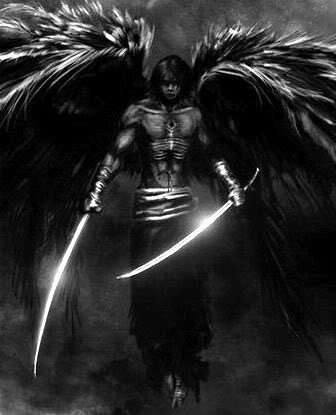
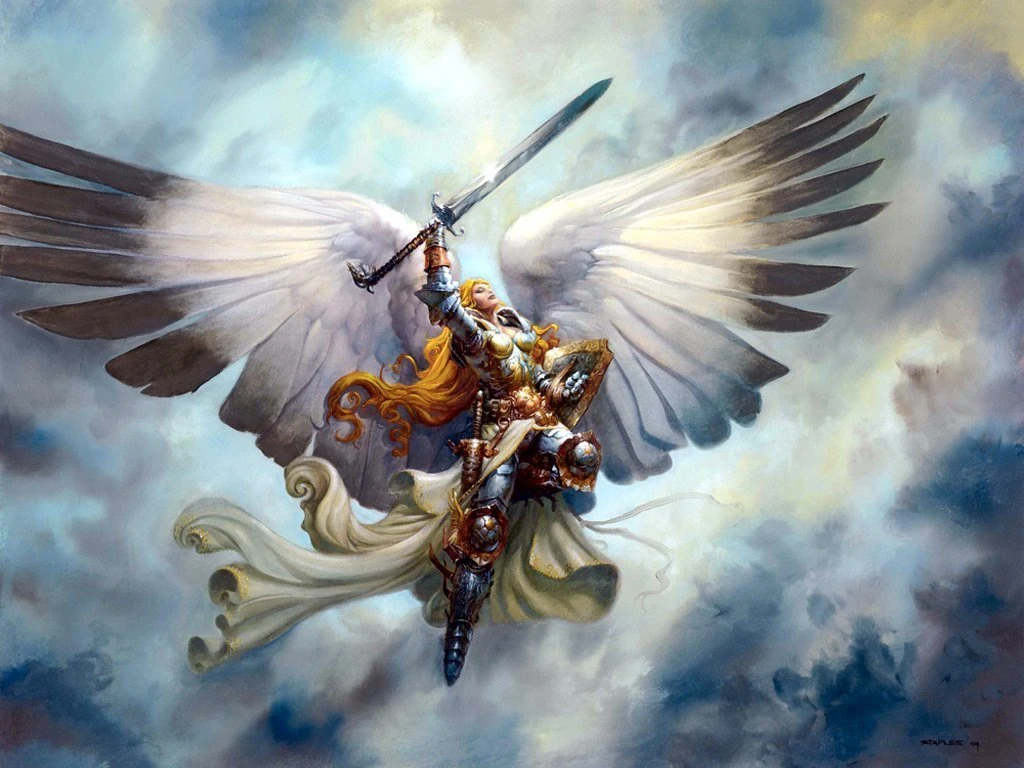
In art, angels are often depicted with bird-like wings on their back, a halo, robes and various forms of glowing light.


In art, angels are often depicted with bird-like wings on their back, a halo, robes and various forms of glowing light.
History of Angels:
The angels are two days and two nights older than we: the Lord
created them on the fourth day, and from their high balcony between the
recently invented sun and the first moon they scanned the infant earth,
barely more than a few wheat fields and some orchards beside the waters.
These primitive angels were stars. For the Hebrews, the concepts of
angel and star merged effortlessly: I will select, from among many, the
passage of the Book of Job (38:7) in which the Lord spoke out of the
whirlwind and recalled the beginning of the world, "When the morning
stars sang together, and all the sons of God shouted for joy." Quite
apparently, these sons of God and singing stars are the same as the
angels. Isaiah, too (14:12), calls the fallen angel "the morning star", a
phrase Quevedo did not forget when he called him "lucero inobediente, ángel amotinado" [defiant
star, rebel angel]. This equivalency between stars and angels (those
populators of nighttime solitudes) strikes me as beautiful; it is among
the distinctions of the Hebrews that they vitalized the astral bodies
with souls, exalting their brilliance into life.
From
the beginning to the end, the Old Testament throngs with angels. There
are ambiguous angels who come along the straight paths of the plain and
whose superhuman nature cannot immediately be divined; there are angels
brawny as farmhands, like the one who fought with Jacob a whole night
until the breaking of the day; there are regimental angels, like the
captain of the Lord's host who appeared to Joshua; there are angels who
threaten cities and others who are like expert guides through solitude;
the angels in God's engine of war number two thousand times a thousand.
The best-equipped angelary, or arsenal of angels, is the Revelation of
St. John: there are the strong angels, who cast out the dragon; those
who stand at the four corners of the earth so that it does not blow
away; those who gather up the clusters of the vine of the earth and cast
them into the great winepress of the wrath of God; those who are
implements of wrath; those who are bound in the great river Euphrates
and let loose like tempests; those who are a mixture of eagle and man.
Islam,
too, knows of angels. The Muslims of Cairo live blotted out by angels,
the real world virtually deluged by the angelic, for according to Edward
William Lane, each follower of the Prophet is assigned two guardian
angels, or five, or sixty, or one hundred and sixty.
The Celestial Hierarchy,
erroneously attributed to the Greek convert Dionysius and composed
around the fifth century of our era, is a highly documented ranking of
angelic order that distinguishes, for example, between the cherubim and
the seraphim, allocating to the first the full, perfect, and overflowing
vision of God and to the second an eternal ascension toward Him in a
gesture both ecstatic and trembling, like a sudden blaze rushing upward.
Twelve hundred years later, Alexander Pope, archetype of the learned
poet, would recall this distinction when he penned his famous line: "As
the rapt seraph, that adores and burns..."
Theologians,
admirable in their intellectualism, did not shrink from angels and
tried to penetrate this world of wings and mirages with their reasoning
minds. This was no uncomplicated matter, for angels had to be defined as
beings superior to man but necessarily inferior to divinity. The German
speculative theologian Rothe records numerous examples of the push and
pull of this dialectic. His list of angelic attributes include
intellectual force; free will; immateriality (capable, however, of
accidentally uniting itself with matter); aspatiality (neither taking up
any space nor being enclosed by it); lasting duration, with a beginning
but without end; invisibility, and even immutability, an attribute that
harbors them in the eternal. As for the faculties they exercise, they
are granted the utmost suppleness, the power of conversing amongst
themselves instantaneously without words or signs, and that of working
wonders, but not miracles. They cannot create from nothing or raise the
dead. The angelic zone that lies halfway between God and man is, it
would seem, highly regulated.
The Kabbalists also made use of angels. Dr. Erich Bischoff, in his German book entitled The Elements of the Kabbalah, published in Berlin in 1920, enumerates the ten sefiroth, or
eternal emanations of divinity, and makes each correspond to one of the
regions of the sky, one of the names of God, one of the Ten
Commandments, one part of the human body, and one class of angels.
Stehelin, in his Rabbinical Literature, links the first ten letters of the aleph-beth, or alphabet of the Hebrews, to these ten lofty worlds. Thus the letter aleph corresponds
to the brain, the First Commandment, the sky of fire, the divine name
"I Am That I Am," and the seraphim known as the Sacred Beasts. Those who
accuse the Kabbalists of imprecision are clearly mistaken. They were,
instead, fanatics of reason, and they delineated a world of deification
by installments that was nevertheless as rigorous and causal as the one
we feel now...
Such a swarm of angels cannot
have avoided meddling in literature. The examples are inexhaustible. In
the sonnet by Juan de Jáuregui to Ignatius Loyola, the angel retains his
biblical strength, his combative seriousness:
Ved sobre el mar, porque su golfo enciendaEl ángel fuerte, de pureza armado.[Look to the sea, for its gulf is set aflame/by the strong angel, armed with purity]
For Luis de Góngora, the angel is a valuable decorative trinket, good for gratifying ladies and children:
¿Cuándo será aquel día que por yerrooh, Serafin, desates, bien nacido,Con manos de Cristal nudos de Hierro?[When will the day be that in error/oh, Seraph, you unloose, well-born/Knots of Iron with your Crystalline hands?]
In a sonnet by Lope de Vega, I ran across the agreeable and very twentieth-century metaphor:
Cuelgan racimos de ángeles[Clusters of angels dangle]
And these angels, with a whiff of the countryside about them, are from Juan Ramón Jiménez:
Vagos ángeles malvasapagaban las verdes estrellas[Vague angels, mauve as mallows,/were putting out the green stars]
Here
we arrive at the near miracle that is the true motive for this writing:
what we might call the survival of the angel. The human imagination has
pictured a horde of monsters (tritons, hippogriffs, chimeras, sea
serpents, unicorns, devils, dragons, werewolves, cyclopes, fauns,
basilisks, demigods, leviathans, and a legion of others) and all have
disappeared, except angels. Today, what line of poetry would dare allude
to the phoenix or make itself the promenade of a centaur? None; but no
poetry, however modern, is unhappy to be a nest of angels and to shine
brightly with them. I always imagine them at nightfall, in the dusk of a
slum or a vacant lot, in that long, quiet moment when things are
gradually left alone, with their backs to the sunset, and when colors
are like memories or premonitions of other colors. We must not be too
prodigal with our angels; they are the last divinities we harbor, and
they might fly away.
FACTS ABOUT ANGELS
- Angels are created and unlike the believer, they are not born of God. “Praise Him, all His angels, praise Him, all His Heavenly hosts... Let them praise the name of the Lord, for He commanded and they were created ” Psalm 148:1-5.
- The word ‘Angel’ is from the Greek ‘angelos’ which means messenger. Angels, therefore, carry messages from God.
- Angels are spirit beings. They are invisible but have the ability to manifest in the physical realm.
- Angels look like human beings and can appear as strangers (Genesis 19:1-3; Hebrews 13:2 which says: “Do not forget to entertain strangers, for by so doing some people have entertained angels without knowing it.”).
- Angels often manifest in dreams and visions. “One day at about three in the afternoon he had a vision. He distinctly saw an angel of God, who came to him and said, “Cornelius!” Acts 10:3 and Acts 27:23 “Last night an angel of the God whose I am and whom I serve stood beside me...”
- Angels are limited in their speech (Jude 9). They can only say what God has told them to say.
- Angels are always referred to as Masculine. There are no references in the Bible to angels of a feminine or child-like description.
- Angels are not Omnipotent (all powerful). Only God is.
- Angels are not Omnipresent (all present). Only God is.
- Angels are not Omniscient (all knowing) “It was revealed to them that they were not serving themselves but you, when they spoke of the things that have now been told you by those who have preached the Gospel to you by the Holy Spirit sent from Heaven. Even angels long to look into these things.” 1 Pet 1:12
- Angels are incapable of dying “... and they can no longer die; for they are like the angels...” Luke 20:36
- Angels do not rest (Rev 4:8)
- Angels work in the lives of both Christians and non-believers. Their purpose is ultimately to bring glory to God and they do this through helping people see God’s hand at work in their lives.
- Angels have a language distinct from any earthly language. Angels can, however, speak earthly language. “If I speak in the tongues of men and of angels, but have not love, I am only a resounding gong or a clanging cymbal..” 1 Cor 13:1
- Angels do not marry or reproduce (Luke 20:35-36; Matt 22:30).
- There are so many angels that they cannot be counted by human understanding (Heb 12:22; Rev 5:11)
- Angels travel between Heaven and earth in a split second (Ezek 1:14). Remember that there is no time or distance in the Spirit world.
- Angels are powerful beings, mighty in strength (2 Thess 1:7; Rev 10:1; 20:1-3). They are more powerful than satan and his cohorts.
- When angels speak we can receive their message as from God (Heb 2:2).Their words cannot be broken. “We must pay more careful attention...to what we have heard, so that we do not drift away. For if the message spoken by angels was binding, and every violation...received its just punishment...”
- Angels are not to be worshipped (Rev 22:8-9). They are our fellow servants.
- We will one day judge the fallen angels (1 Cor 6:3).
Here is a documentary video that gives an account of History of Angels.


